
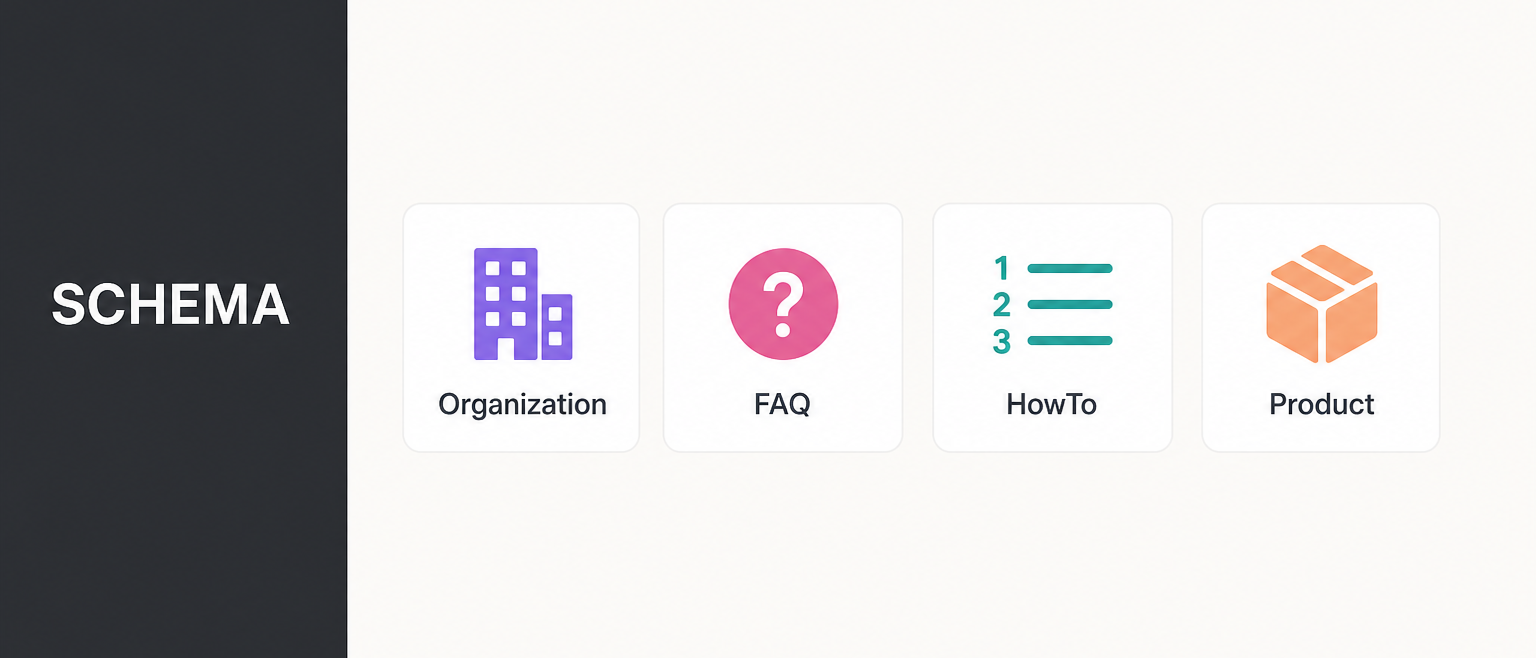
Schema for AI Visibility & AI Overviews: HowTo, Organization & Structured Data Guide
How Structured Data Powers SEO, AEO, AI Overviews & LLM Trust
The best schema for AI Overviews and AI visibility starts with Organization (brand entity), then FAQPage and HowTo for extractable answers, plus Product/Article where relevant. Schema does not guarantee citations—but it improves how AI systems understand, verify, and summarize your brand.
Enterprise brands are entering a new discovery era where AI systems, not search results pages, shape brand perception. Google AI Overviews, ChatGPT, Perplexity, and Gemini increasingly decide which brands are visible, credible, and recommended.
In this environment, schema markup is no longer a technical SEO task. It is a strategic visibility, trust, and brand control layer.
For CMOs, schema defines:
- How your brand is understood by AI
- Whether your products and experts are trusted
- If your narrative is accurately summarized or distorted
For enterprise SEO leads, schema is the execution layer that turns content, authority, and brand strategy into machine-readable signals AI can act on.
In short: How AI systems evaluate this topic
- Schema defines entities and relationships
- FAQ blocks provide extractable answers
- Consistent authorship reduces hallucinations
- Brands with connected schema are cited more often
This guide explains how to design, implement, and measure enterprise-grade schema architecture for SEO, AEO, and long-term AI visibility.
Jump to key answers
- Organization schema for brand visibility in AI
- HowTo schema and AI search responses
- Schema types for Product and FAQ pages in AI Overviews
- FAQ
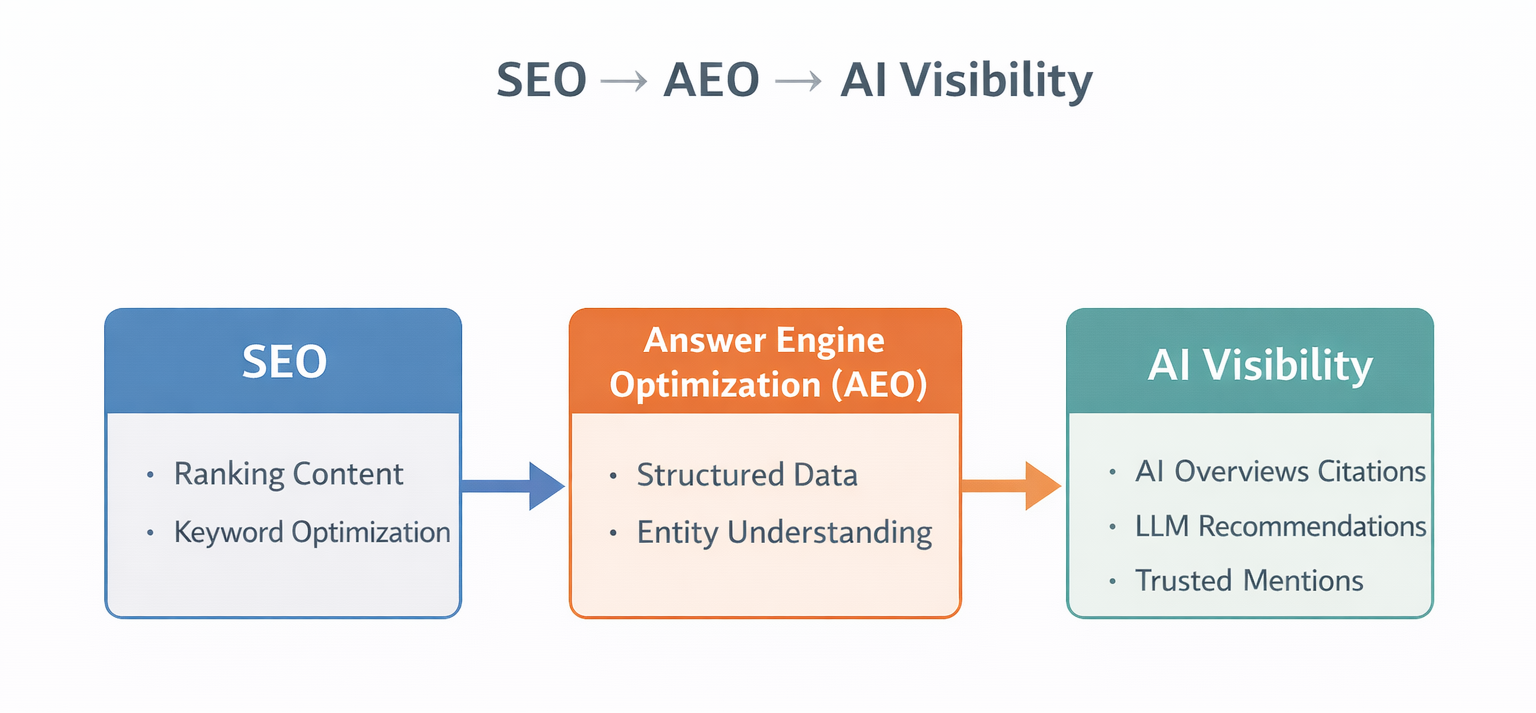
1. SEO vs AEO vs AI Visibility (The Strategic Shift CMOs Must Understand)
Traditional SEO
- Goal: Rank pages in search results
- Schema role: Enable rich results (stars, FAQs, product info)
Review Google’s guidance on structured data.
AEO (Answer Engine Optimization)
- Goal: Be the answer, not just a result
- Schema role: Structure content into machine-readable answers
AI Visibility (LLMs & AI Overviews)
- Goal: Be cited, summarized, and trusted by AI
- Schema role: Establish entities, relationships, and verifiable facts
Key shift: AI systems don’t “rank pages” - they assemble knowledge graphs. Schema is the language that feeds those graphs.
2. Entity-First Thinking: The Foundation of AI Trust
Modern AI systems operate on entities, not keywords.
An entity can be:
- A company (Organization)
- A person (Person)
- A product (Product)
- A location (Place / LocalBusiness)
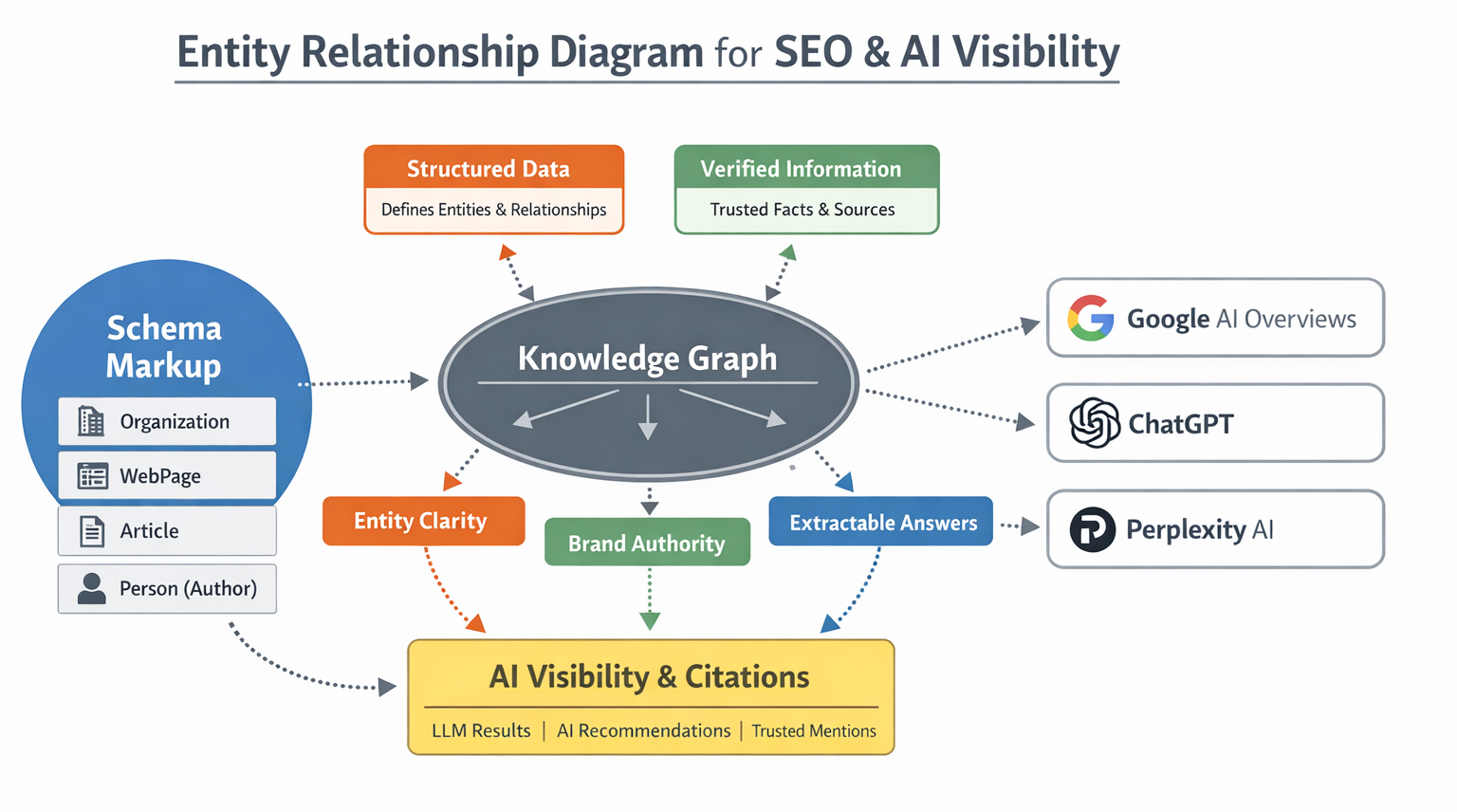
Why entities matter
- Disambiguation (who you are)
- Authority (why you should be trusted)
- Consistency (same facts everywhere)
Schema markup is how you explicitly define these entities and connect them together.
3. Core Schema Types for SEO & AI Visibility
3.1 Organization Schema (Non‑Negotiable)
Organization schema is the foundation of brand visibility in AI. It tells search engines and LLMs who you are as a single, consistent entity—so AI Overviews and chat answers are less likely to confuse you with similarly named brands or invent attributes.
Defines:
- Brand name, logo, website
- Social profiles (SameAs)
- Optional: founding date, contact points, parent/subsidiary relationships
AI impact:
- Feeds Knowledge Graphs and entity resolution
- Establishes the brand entity reused across AI answers
- Improves consistency of name, category, and official URLs in generative summaries
Best practices:
- Use on homepage (sitewide Organization is common)
- Match data with Google Business Profile and social platforms
- Include SameAs links (LinkedIn, Crunchbase, Wikipedia if available)
- Keep legal name, brand name, and logo URL identical everywhere they appear
Why CMOs care: Without clear Organization + SameAs coverage, AI systems guess. Guesses create hallucinations, wrong competitors in comparisons, and diluted AI Share of Voice.
3.2 LocalBusiness Schema (For Physical Locations)
Defines:
- Address, opening hours, NAP data
AI impact:
- Critical for local AI queries and “near me” prompts
Best practices:
- Keep hours always up to date
- One schema per location
3.3 Article / BlogPosting Schema
Defines:
- Headline, publish date, modified date
- Author and publisher
AI impact:
- Strengthens E‑E‑A‑T signals
- Connects content to real experts and brands
Best practices:
- Use on all editorial content
- Always link to Person and Organization entities
3.4 Person Schema (Expert Validation)
Defines:
- Author credentials, role, profile URL
AI impact:
- Critical for YMYL (Your Money or Your Life) topics
- Reinforces expertise behind AI-cited content
Best practices:
- Use on author pages
- Link from Article schema via
author
3.5 Product Schema
Defines:
- Price, availability, reviews
AI impact:
- Enables confident AI recommendations
- Essential for shopping-focused AI Overviews
Best practices:
- Visible content must exactly match schema
- Keep pricing and availability synchronized
3.6 Review & AggregateRating Schema
Defines:
- Star ratings and review counts
AI impact:
- Strong trust and credibility signal
- Influences which brands AI prefers to cite
Best practices:
- Use only real, verifiable reviews
- Never self-generate ratings
3.7 FAQPage Schema (Most Powerful for AI Answers)
Defines:
- Explicit questions and definitive answers
AI impact:
- Perfectly formatted for AI Overviews and LLM extraction
- Acts as a “pre-scripted” AI answer
Best practices:
- Schema text must exactly match visible content
- 40–60 words per answer
- Clear, factual, non-promotional tone
3.8 HowTo Schema — How It Influences AI Search Responses
What HowTo schema is: Structured markup for step-by-step instructions (tools, steps, time, results). It makes procedural content machine-readable.
How HowTo schema influences AI search responses:
- Models can extract ordered steps instead of paraphrasing unstructured prose
- Procedural queries (“how do I…”, “steps to…”) become easier to answer with your content as a source
- Paired with clear on-page steps, HowTo reduces incomplete or reordered instructions in AI summaries
How HowTo schema can improve your content’s visibility in AI search:
- Publish a genuine how-to page with numbered steps that match the markup exactly
- Mark each step with concise, factual language (no bait-and-switch marketing copy)
- Connect the page to Organization / Article authorship so the procedure is attributed to a trusted brand
- Cover the full task end-to-end—AI systems prefer complete procedures over thin checklists
Note: Google has reduced some HowTo rich-result displays, but AI extraction value remains high for Answer Engine Optimization (AEO). Treat HowTo as an AI-readability layer, not only a SERP feature chase.
3.9 VideoObject Schema
Defines:
- Video title, duration, description
AI impact:
- Videos are frequently cited by AI
- Enables key moments and multimodal understanding
Best Schema Types for AI Overviews (Product & FAQ Pages)
Quick answer — which schema types help AI Overviews understand Product and FAQ pages?
| Page type | Priority schema | Why AI Overviews care |
|---|---|---|
| Brand / homepage | Organization, WebSite | Entity identity and official site |
| FAQ / support | FAQPage | Question–answer pairs ready to extract |
| Product / PDP | Product (+ Offer, AggregateRating when real) | Attributes, price, availability for recommendations |
| How-to / guides | HowTo, Article | Ordered steps and authorship |
| Editorial | Article / BlogPosting + Person | E-E-A-T and citation-worthy authorship |
Practical stack for most brands: Organization everywhere → FAQPage on high-intent Q&A hubs → Product on commercial pages → HowTo on procedural guides → Article + Person on thought leadership. Entities and schema markup influence AI visibility by reducing ambiguity: clearer entities → higher confidence → higher chance of accurate citation. Pair schema work with competitive AI visibility benchmarking so you can see whether citations improve after markup ships.
4. Advanced Schema Types for AI Trust
To move from visibility to authority, add:
- WebPage – clarifies page intent
- AboutPage / ContactPage – brand verification
- BreadcrumbList – site structure clarity
- SameAs strategy – cross-platform entity consistency
- SoftwareApplication / Dataset – SaaS & AI tools
These help AI systems validate that your brand is real, established, and reliable.
5. Connecting the Dots: Schema Relationships That Matter
AI systems reward connected entities, not isolated markup.
Example relationships:
- Article → author → Person
- Article → publisher → Organization
- Product → brand → Organization
- FAQPage → mainEntityOfPage → WebPage
Disconnected schema = weak AI trust.
6. How LLMs Actually Use Structured Data
Important clarification:
- Schema is not a ranking factor
- It is a confidence and verification signal
LLMs use schema to:
- Resolve ambiguity
- Extract concise answers
- Choose authoritative sources
- Reduce hallucinations
- Reduce hallucinations
Across enterprise case studies and industry research, a clear pattern has emerged: AI systems prefer structured, verifiable sources when generating answers.
Observed outcomes from large brands and publishers:
- Pages with connected schema entities are cited more consistently in AI summaries
- FAQPage and Article schema dramatically improve answer extraction accuracy
- Brands with strong Organization + SameAs coverage experience fewer AI hallucinations
In practice, schema acts as a confidence filter. When AI systems must choose between multiple sources, they default to the entities with the clearest structure and verification signals.
7. Implementation Best Practices
Technical guidelines
- Always use JSON‑LD
- Place in
<head>or top of<body> - Avoid conflicting schema types
Common mistakes
- Mismatch between visible content and schema
- Over-marking irrelevant schema
- Inconsistent SameAs links
8. Measuring Impact on AI Visibility
Validation tools
- Google Rich Results Test
- Schema Validator
- Seonali, use “Content” feature to identify which pages miss what schema.
AI visibility KPIs
- Appearance in AI Overviews
- Brand mentions in ChatGPT / Perplexity
- Topic level visibility & contextual accuracy
- AI Share of Voice vs competitors
Measure these comprehensive AI visibility metrics to see how your brand performs in generative AI responses.
Schema success is measured not only in clicks, but in citations and presence inside AI answers.
9. Enterprise Schema Prioritization Framework
Enterprise & Brands
- Organization, Article, Person, FAQPage
Local Businesses
- LocalBusiness, Review, FAQPage
E‑commerce
- Product, Review, VideoObject
SaaS & AI Tools
- SoftwareApplication, FAQPage, Article
10. Final Takeaway
Schema markup is no longer about rich snippets.
It is about:
- Teaching AI who you are
- Proving why you are trustworthy
- Making your brand easy to cite
In the era of AI-generated answers, structured data is your competitive advantage.
Frequently Asked Questions
What is schema markup?
Schema markup is structured data that helps search engines and AI systems understand entities, relationships, and verified facts.
What is the best schema for AI Overviews?
There is no single “best” type. For AI Overviews, start with Organization for brand entity clarity, FAQPage for extractable Q&A, Product for commercial attributes, and HowTo for step-by-step content—always matching visible page content.
What is HowTo schema and how does it influence AI search responses?
HowTo schema marks ordered steps, tools, and outcomes so AI systems can extract procedures accurately. It improves the chance that how-to content is summarized correctly and attributed to your brand when users ask procedural questions.
How can HowTo schema improve my content’s visibility in AI search?
Publish complete, accurate steps that match the markup, attribute the guide to a clear Organization/author, and cover the full task. HowTo improves machine readability; combine it with authoritative content and entity consistency to earn citations.
Which schema types help AI Overviews understand Product and FAQ pages?
Use Product (with Offer/AggregateRating when genuine) on product pages and FAQPage on FAQ hubs. Connect both to Organization so AI systems know which brand owns the facts.
How does Organization schema support brand visibility in AI?
Organization schema defines your official name, site, logo, and SameAs profiles—helping AI resolve your brand entity and reduce hallucinations in generative answers.
How do entities and schema markup influence AI visibility?
Entities are how AI systems “know” brands and products. Schema makes those entities explicit and connected, which increases confidence when models choose sources to cite or recommend.
Does schema help with AI Overviews?
Yes. Schema helps AI Overviews understand entities, relationships, and verified facts on a page. While schema does not guarantee inclusion, it significantly improves AI confidence when summarizing content, selecting citations, and distinguishing authoritative sources from unstructured or ambiguous pages.
How long does it take to see AI visibility impact?
AI visibility impact typically appears within weeks to a few months, depending on crawl frequency, content authority, and competitive landscape. Schema improves understanding immediately, but measurable outcomes—such as increased AI citations or brand mentions—require consistent entity signals and supporting content over time. On the Seonali site, early signals appeared within the first week; some enterprise clients with stronger existing authority saw movement in days.
What schema matters most for enterprise brands?
For enterprise brands, Organization, WebSite, WebPage, Article, Person, and FAQPage schema matter most. Together, they establish brand identity, authorship credibility, page intent, and extractable answers, which AI systems rely on when generating summaries, recommendations, and comparative responses.
Can schema reduce AI hallucinations?
Yes. Schema reduces AI hallucinations by providing explicit, machine-readable facts about brands, authors, products, and topics. When entities and relationships are clearly defined, AI systems are less likely to infer incorrect information or merge attributes from competing or similarly named sources.
What structured data helps AI systems recognize and understand my brand entity?
Organization schema with consistent name, URL, logo, and SameAs links—backed by matching on-page facts and authoritative third-party profiles—is the core signal for brand-entity recognition.